We are seeing a greater number of Energy utilities issue bonds in the AUD-bond market as their capex requirements increase. Whilst some companies will be household names, others will be new to investors. When deciding which bonds to invest in, it is important to understand what each company does and where they sit in the Energy supply chain. Here we discuss the complex ecosystem of the energy supply chain and the key thematics playing out in the sector.
Background
The Energy market is a complex ecosystem made up of multiple companies that have different roles to play. When analysing bonds to include in a bond portfolio, it is important to understand where the company sits in the energy supply chain. These differences can impact the credit metrics and pricing of bonds issued within the sector.
This sector is highly regulated, meaning revenues are set by the regulator rather than the market. This provides predictable and reliable revenues but also influences how investors evaluate capital expenditure.
There are two significant thematics at play that will have a long-term influence on this sector. These are the shift to renewable energy and the data centre boom.
Energy Supply Chain
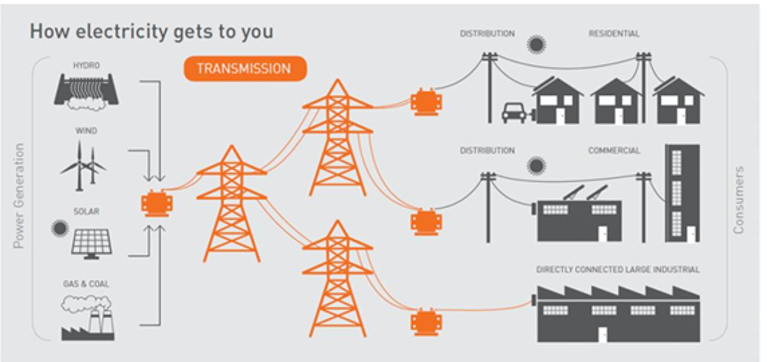
The electricity utility sector is often treated as one homogenous group, but meaningful analysis requires an understanding of each company’s place in the energy value chain. The three main stages are energy generation, distribution and transmission. The diagram below illustrates what each stage encompasses.
Figure 1: Stages of Energy production Source: Energy Networks Australia
Source: Energy Networks Australia
Generation is the most recognisable stage of the energy value chain, as it is where electricity is produced. Historically this has been from fossil fuels such as gas and coal, but this is now shifting towards renewable sources such as solar, wind and hydro. Companies operating in this segment are the most exposed to the renewable energy transmission. Some of the generation companies that FIIG trades on behalf of clients are in renewable only, while others primarily use traditional sources of energy generation but are starting to incorporate renewable methods. The shift to include renewable sources has been done through mergers and acquisitions of existing projects and new greenfield projects.
Transmission and distribution are the two stages where investors may not naturally see clear differences. Both of these stages carry energy through poles and wires, but the scale and attachment points are the differentiators. Transmission is the bulk distribution of high voltage energy from the generators to demand centres. The distribution network then takes the electricity from these demand centres to the end clients. The end clients can be residential, commercial or industrial. The high voltage electricity in the transmission network is converted into lower voltages by substation transformers before being carried across the distribution network.
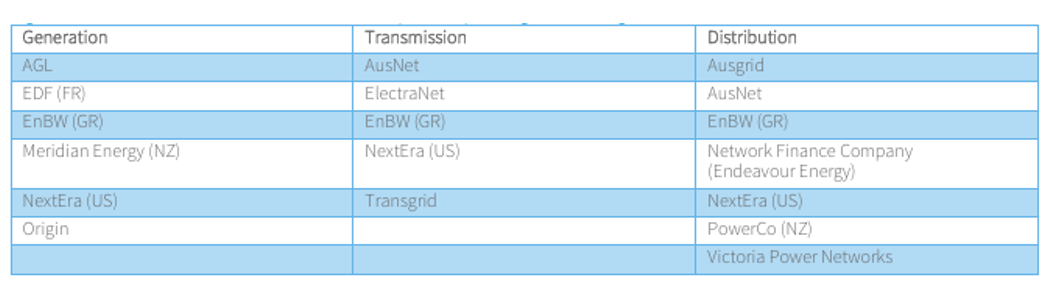
Companies operating in the transmission stage are not competitors of companies operating in the distribution stage due to these differences. They are companies that coexist in the electricity ecosystem, with a reliance on each other to perform their own tasks. Distribution companies generally do not actively choose their transmission provider, instead it is typically determined by the entity operating within the relevant geographic region. Is it important for fixed income investors to be aware of what stage each company operates in as this will affect how credit metrics are viewed as well as relative value comparisons.
Figure 2: Energy companies operating in each stage
Source: Energy Networks Australia
Key Energy Sector Themes
The Energy sector is entering into a period of elevated capex which is primarily due to two themes: the renewable energy transition and increased demand driven by data centres. As companies move away from fossil fuels and towards renewable energy sources, they will need to spend a considerable amount on adjusting their network and generation assets. Data centres are something that will increase total energy demand by a significant amount and require additional capacity to be built into the network. Power demand is outpacing GDP growth rates in many countries due to ongoing electrification and new facilities such as data centres.
The energy transition primarily effects generators, however it requires adjustments to all stages of the network. Generators need to spend money to build or acquire assets that can generate energy from renewable sources. The rest of the network needs to be upgraded to handle bi-directional flows as solar is sent back to the grid and build batteries to store renewable energy. The increase in spending in this area is evident by the amount of energy issuers coming to market, especially in green format. This funding is used for increasing and upgrading the network and capital inducive renewable generation assets. There has also been a recent focus on battery projects such as Ausgrid’s new unregulated business PLUS Grid Storage. Companies like Meridian Energy are pure play renewable companies that are well placed to benefit from the energy transition.
Data centres are poised to drive the largest surge in electricity demand that we have seen in decades. These facilities house large amounts of servers and other IT equipment and are required to be operating at all times. Because of this, their energy usage is huge and is only expected to increase going forward. At AusNet’s January update, they had a total pipeline of 8 GigaWatts (GW) of data centre related demand either in development or inquiry and Ausnet only operate in Victoria. To put that into perspective, 1GW can power 300,000 homes. This additional capacity will not be able to be found using the existing generators and will require adding further capacity to the network. This means significant capex but also a large increase in the asset bases of generators, transmission and distribution companies. This is a short-term cost in order to generate years of increased revenue and greater capacity. There’s also a possibility that some of this business could sit outside the regulated divisions of energy providers, creating potential for greater revenue generation.
The scale of growth in data centres is unprecedented. So far this year, we have seen the Australian record for size of a data centre contract broken twice. In April, NextDC set the record with a 250-megawatt contract and in May CDC smashed this record with a 555-megawatt contract. These contracts are with a large US hyperscalers such as AWS, Microsoft, Meta etc. These are well-capitalised companies seeking to deploy significant capital rapidly within this space. Putting this into perspective, prior to this deal the total capacity of data centre deals that CDC had signed over 19 years was 550 megawatts. One contract alone is greater than the entire contracted capacity they have had over a 19-year period.
A key task for these companies will be completing these large capex plans whilst maintaining their credit metrics. Once they have gone through this growth phase, they should have considerable larger asset bases which should translate into higher revenues, especially for regulated companies. Across the 19 Australian and New Zealand companies that rating agency S&P rate, they expect credit metrics to remain stable. Their credits are supported by predictable revenues and their ability in many cases to delay some of these capex projects as required. We have seen some issuers such as Transgrid and AusNet use subordinated notes in order to raise capital without placing pressure on their credit metrics.
Conclusion
The energy sector is undergoing a vast transformation at the moment, with further growth and development still to play out. With the amount of new issuance coming to market, it offers fixed income portfolios attractive returns and exposure to the utilities sector, however understanding where the issuer sits within the supply chain is important for peer comparison and assessing relative value. We expect further opportunities in the sector as it continues to evolve.